

Nowadays, the term AI is ubiquitous, permeating corporate board meetings, online forum platforms, and casual conversations among friends. In Part 1 we presented an introduction to Artificial Intelligence, explored its recent evolution, and highlighted its transformative nature. In this post, we delve deeper into the societal impact of AI adoption, specifically examining its effects on the job market.
Explain how the transition to a world dominated by AI will be disruptive for the job market
ChatGPT: The transition to a world dominated by AI is expected to be disruptive for the job market due to several reasons:
- Job Displacement: AI technologies have the potential to automate repetitive and routine tasks, which can lead to job displacement in certain industries. Jobs that are highly predictable and rule-based are more susceptible to automation, potentially impacting a significant portion of the workforce.
- Skill Shift: The rise of AI may require workers to acquire new skills to remain relevant in the job market. As certain tasks become automated, there will be a greater demand for skills such as data analysis, problem-solving, critical thinking, and creativity. Workers will need to adapt and upskill to meet the changing demands of the AI-driven workplace.
- Uneven Impact: The disruptive effects of AI will likely vary across industries and job categories. Some sectors may experience significant job losses, while others may see job creation and restructuring. The impact may also differ based on factors such as education level, geographic location, and industry specialization, leading to potential inequalities and disparities.
- Job Transformation: While some jobs may be completely automated, others are likely to undergo transformation. AI can augment human capabilities and improve productivity, leading to the restructuring of job roles and tasks. Workers may need to collaborate more closely with AI systems, requiring new skills and a shift in job responsibilities.
- Reshaping Industries: AI has the potential to reshape entire industries, leading to the emergence of new job opportunities and the decline of traditional roles. Sectors such as healthcare, finance, transportation, and customer service are already experiencing the impact of AI, altering job requirements and creating a need for different skill sets.
- Economic Impact: The disruptive nature of AI on the job market can have broader economic implications. Displacement of workers and changes in job structures can result in income inequality, unemployment challenges, and the need for social safety nets and retraining programs to support affected individuals and ensure a smooth transition.
While the transition to an AI-dominated world will bring disruptions to the job market, it also presents opportunities. New industries and job roles will emerge, and AI can enhance productivity, improve decision-making, and lead to innovation. However, proactive measures such as education and training programs, supportive policies, and a focus on lifelong learning will be crucial to navigate the job market disruptions and ensure a smooth transition for workers.
Which jobs are prone to automation and which occupations face the highest risk of displacement?
ChatGPT: Jobs that involve routine and repetitive tasks are more likely to be susceptible to automation and thus have a higher risk of being disrupted or eliminated by AI technologies. Some occupations that may be particularly at risk include:
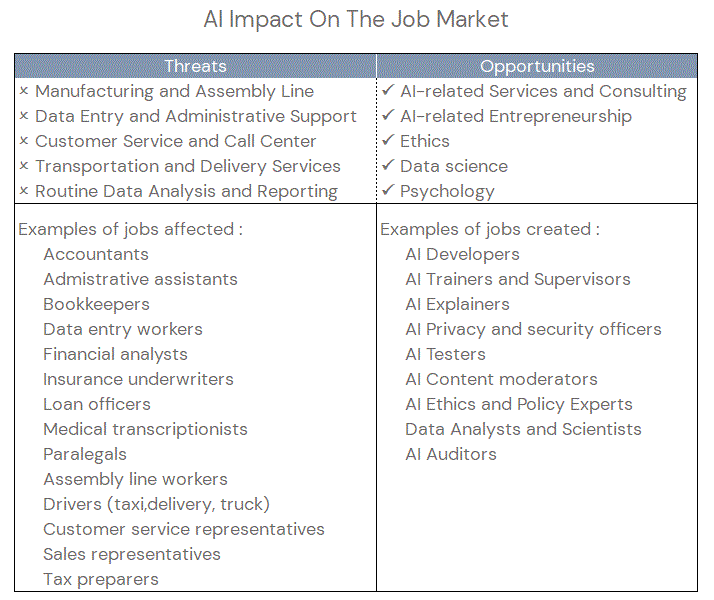
- Manufacturing and Assembly Line Workers: Jobs involving manual assembly or repetitive tasks in manufacturing industries are increasingly being automated with robotic systems.
- Data Entry and Administrative Support: With advancements in natural language processing and optical character recognition, AI can automate data entry and perform basic administrative tasks, reducing the need for human intervention.
- Customer Service and Call Center Operators: AI-powered chatbots and virtual assistants are becoming more sophisticated, capable of handling customer inquiries and providing support without human involvement.
- Transportation and Delivery Services: The rise of autonomous vehicles and drones has the potential to disrupt jobs in transportation and delivery, such as truck drivers and delivery personnel.
- Routine Data Analysis and Reporting: AI algorithms can process large volumes of data, perform data analysis, and generate reports, potentially reducing the need for certain roles in data analysis and reporting.
It is important to note that while these occupations may face potential disruption, the exact impact will depend on factors such as the pace of AI development, technological adoption, and the ability of industries and workers to adapt to changing demands. Additionally, new job opportunities may arise in fields related to AI development, maintenance, and oversight, as well as roles that require creativity, complex problem-solving, and interpersonal skills that are less easily automated.
Elaborate on the new job/economic opportunities that AI will create
ChatGPT: The rise of AI is expected to create new job and economic opportunities in various areas, including:
- AI Specialists: The growing demand for AI technologies will lead to an increased need for experts in machine learning, deep learning, natural language processing, and data science. AI specialists will play a crucial role in developing, implementing, and maintaining AI systems.
- Data Analysts and Scientists: As AI relies heavily on data, there will be a greater demand for professionals skilled in data analysis, data engineering, and data science. These roles involve extracting insights, making data-driven decisions, and optimizing AI models.
- AI Trainers and Supervisors: AI systems require extensive training and continuous monitoring. Professionals who can curate high-quality training datasets, fine-tune AI models, and ensure ethical considerations will be in demand.
- Ethical and Policy Experts: With the ethical implications of AI becoming increasingly important, there will be a need for professionals who can address issues such as algorithmic bias, privacy concerns, and transparency. Ethicists, policy analysts, and legal experts will play a vital role in shaping responsible AI practices and regulations.
- AI-Augmented Roles: AI technologies can enhance productivity and decision-making across various professions. Professionals in sectors like healthcare, finance, marketing, and customer service will need to adapt to working alongside AI systems, leveraging AI-generated insights and recommendations to improve their work.
- AI-Related Services and Consulting: As AI adoption expands, there will be a demand for consultants, trainers, and service providers who can assist organizations in integrating AI technologies, developing AI strategies, and providing ongoing support.
- Innovation and Entrepreneurship: The AI revolution will spur innovation and create opportunities for entrepreneurs. Startups focused on AI applications, robotics, automation, and AI-driven products and services are likely to emerge, contributing to economic growth and job creation.
- Reskilling and Training: The transition to an AI-dominated world will necessitate reskilling and training programs to equip workers with the necessary skills to thrive in the changing job market. Education and training providers will have a role in offering programs to help individuals adapt to the AI era.
While the exact nature and scale of these job and economic opportunities will vary across industries and regions, AI is expected to drive innovation, productivity, and economic growth. Embracing the potential of AI technologies and investing in the development of related skills will be crucial in capitalizing on the opportunities presented by the AI revolution.
Will the jobs created by AI outnumber the jobs destroyed by AI? What will be the net effect on employment levels ?
ChatGPT: The net effect of AI on employment levels is subject to debate and depends on various factors. While AI has the potential to both create and eliminate jobs, it is challenging to predict the exact balance between job creation and destruction. The net effect on employment levels will depend on how AI technologies are implemented, the pace of adoption, and the ability of industries and workers to adapt to the changing job landscape.
Some argue that historically, technological advancements have led to the creation of new industries and job categories that have ultimately outweighed the jobs lost to automation. They suggest that as AI replaces routine and repetitive tasks, it frees up human labor for more complex, creative, and higher-value work, leading to the creation of new jobs that we cannot currently foresee.
Others express concerns that the disruption caused by AI may be more significant than the job creation it brings. Certain occupations may face significant challenges and displacement, particularly those involving routine and repetitive tasks that can be automated. It is essential to address the potential for job polarization, where high-skilled jobs may be created while low-skilled jobs face higher risks.
To mitigate the potential negative effects and maximize the benefits, it is crucial to invest in education, retraining, and upskilling programs to equip workers with the skills needed in the AI-driven economy. Continuous learning and adaptability will be essential for individuals to navigate the evolving job market.
Overall, accurately estimating the net effect of AI on employment levels is complex, and the outcome will depend on various factors, including technological advancements, economic conditions, societal choices, and policy responses.
Key Takeaways:
- The transition to the AI era does carry the potential for widespread job disruption and displacement.
- Jobs that involve routine and repetitive tasks are more likely to be susceptible to automation and thus have a higher risk of being disrupted or eliminated by AI technologies.
- While some jobs may be eliminated or transformed, the AI revolution can also create new job opportunities.
- The net effect of AI on employment levels is subject to debate and depends on various factors.
- Summary table of risks and opportunities:
 AI Talks
Leave a comment