

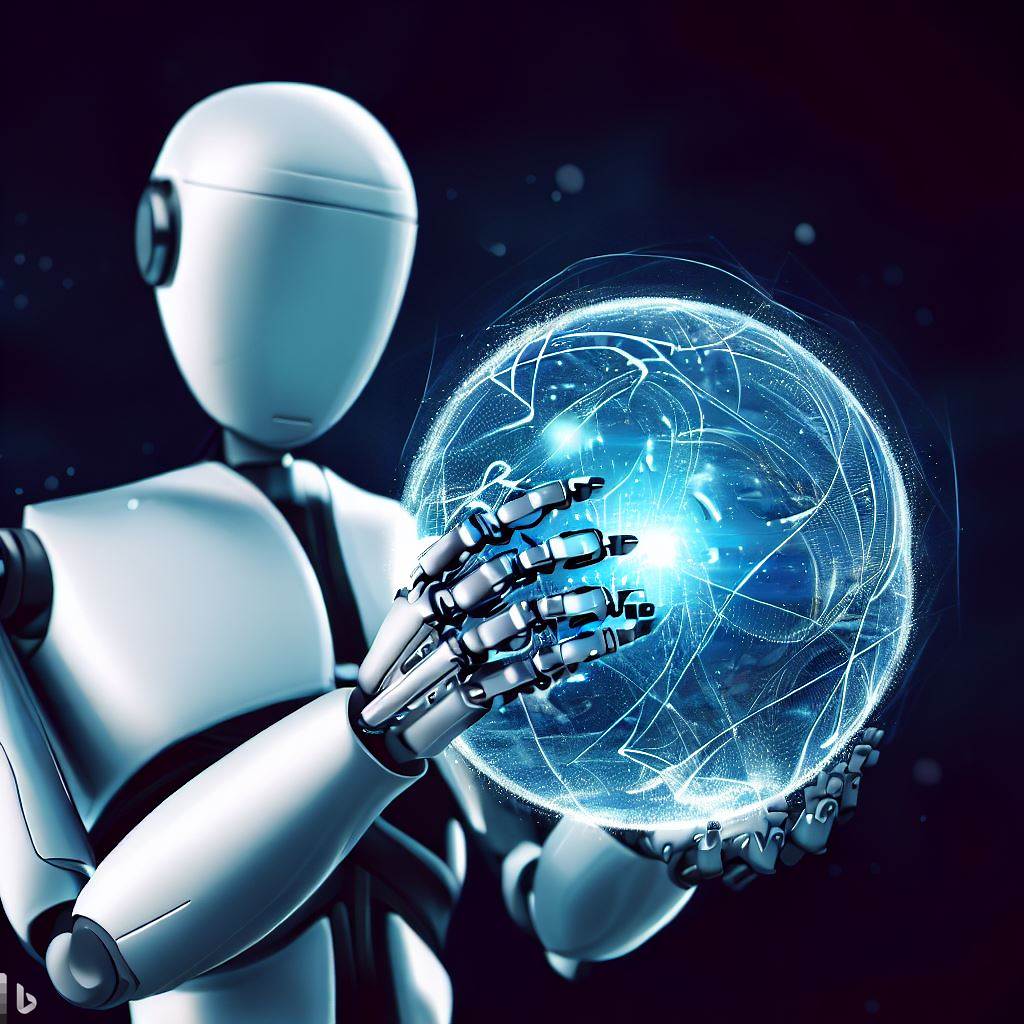
(Images generated by author With BlueWillow / Bing Image Creator)
The fields of artificial intelligence (AI) and quantum computing are both rapidly advancing technologies that promise to transform our world. Though seemingly very different, AI and quantum computing share some interesting connections and together may open up new possibilities we can barely imagine today. In this post, we’ll provide a brief overview of AI and quantum computing individually, discuss how they can interact and complement each other, and explore some of the promising applications that could arise from combining these technologies.
Table of Content
- What is Artificial Intelligence ?
- What is Quantum computing ?
- Research Areas Bringing AI and Quantum Computing Together
- Quantum Parallelism: A Glimpse into the Future of Computing
- Securing AI with Quantum Cryptography
- Reducing AI Cost Burden with Quantum Computing
- The Transformative Potential of Quantum AI
- Challenges in Integrating AI and Quantum Computing
- Conclusion
- Additional Resources
What is Artificial Intelligence ?
Artificial Intelligence (AI) is a branch of computer science that’s focused on developing intelligent machines capable of performing tasks that typically require human intelligence, such as visual perception, speech recognition, and decision-making. AI has seen major breakthroughs in recent years, driven by advances in machine learning (ML) algorithms and neural networks, as well as increases in data and computing power.
Machine learning allows computers to learn and improve at tasks without being explicitly programmed. Neural networks are computing systems modeled on the human brain that can be trained via large amounts of data to recognize patterns and make predictions.
What is Quantum computing ?
Quantum computing involves advanced hardware that exploits quantum mechanical phenomena like superposition and entanglement. Traditional computers store information in binary bits existing as either 1 or 0. Quantum computers use quantum bits or qubits, which can exist as 1 and 0 at the same time, enabling exponentially greater information density and parallelism.
A key goal of quantum computing is to achieve quantum supremacy—when a quantum computer can perform a task that is practically impossible for even the most powerful classical supercomputer to complete. Demonstrating quantum supremacy is a significant experimental milestone in the field, with companies like Google and IBM claiming to have achieved it using prototype quantum computers. While these claims require further scrutiny, the field is rapidly advancing. Major tech firms and startups are now focusing on developing utility-based, commercial-scale quantum computers capable of solving complex problems that are intractable for conventional computers.
Research Areas Bringing AI and Quantum Computing Together
AI and quantum computing were developed mostly independently, but recently there has been growing interest in how they might intersect to create new opportunities. Here are some of the key areas researchers are exploring:
- AI algorithms running on quantum computers – Quantum ML may offer advantages over classical ML in dealing with imperfect, complex data. Researchers are developing quantum ML algorithms that can leverage the parallelism of quantum systems to speed up ML tasks like classification, regression, and clustering. For example, this study highlights the potential improvement to classical machine learning tasks, such as Support Vector Machines (SVMs), from the use of algorithms like the quantum variational classifier and the quantum kernel estimator.
- Quantum-enhanced AI hardware – Quantum processors could act as co-processors to accelerate computationally intensive AI tasks like neural network training. IonQ, Google, IBM, and Rigetti are among the leading companies that are developing quantum processors that can handle complex AI workloads.
- AI optimization of quantum computing – ML can help optimize the calibration of quantum devices by automatically tuning qubits and correcting errors, thereby enhancing performance. AI techniques like reinforcement learning based on neural networks are being researched to potentially optimize error correction strategies for quantum computing.
- Quantum-inspired AI algorithms – Ideas from quantum computing could inspire new AI models. Quantum techniques like tunneling and superposition may improve AI optimization and decision-making.
- Quantum neural networks – While still in the exploration phase, quantum neural networks could represent data patterns using quantum effects like entanglement and interference for new kinds of ML.
Quantum Parallelism: A Glimpse into the Future of Computing
One particularly captivating facet of quantum computing is its potential for parallel processing. Quantum parallelism refers to the ability of quantum computers to evaluate multiple possibilities simultaneously due to the superposition principle. As mentioned previously, qubits can represent a combination of 1 and 0 at the same time, allowing quantum algorithms to explore many potential solutions in parallel.
A simple example is searching an unstructured database. A classical computer would have to check each entry in sequence to find the target value. A quantum computer utilizing quantum parallelism could examine all entries simultaneously.
Securing AI with Quantum Cryptography
Cryptography keys generated through common current methods lack verifiable unpredictability (quantum randomness), potentially exposing encrypted data and systems to severe vulnerabilities. Quantum encryption can minimize these vulnerabilities by allowing the creation of very strong encryption keys, such as quantum-computing-hardened cryptographic keys. This could make it extremely difficult for hackers to attack AI systems.
As an example, quantum encryption could significantly enhance security for an AI system managing a nuclear power plant’s reactors, making it extremely challenging for hackers to access the system without authorization. Robust quantum encryption will be an important safeguard as AI becomes prevalent in high-risk settings.
Reducing AI Cost Burden with Quantum Computing
Quantum computing shows promise for reducing the escalating computational costs of developing and deploying AI systems.
First, quantum machine learning algorithms can shrink the time required for deep learning model training from weeks to hours. Quantum processors designed as AI co-processors could also accelerate inference (predictions), lowering overhead for real-time AI applications like autonomous driving.
Additionally, quantum computer, in certain instances, exhibit the potential for greater energy efficiency when compared to conventional hardware, possibly reducing power consumption of specific AI workloads.
Finally, quantum simulators can efficiently generate massive synthetic datasets to train machine learning models at a fraction of the cost of generating training data through traditional means. An AI model predicting protein structures could be trained much faster and cheaper using abundant data from quantum simulations of molecular dynamics rather than relying solely on expensive and time-consuming lab analysis.”
The Transformative Potential of Quantum AI
The synergistic fusion of AI and quantum computing could enable transformative breakthroughs across industries. Below are some examples showcasing the immense potential of combining these technologies for selected sectors:
- Healthcare – AI analyzes medical data to identify drug targets. Quantum computing could accelerate clinical trials and drug discovery by rapidly analyzing massive datasets that are beyond the scope of classical computing.
- Financial Services – AI enables automated fraud detection and trading algorithms. Quantum computing could radically improve these tasks by rapidly processing enormous datasets and running market simulations with exponentially more variables.
- Materials Science – AI can identify patterns and properties in materials data. Quantum computing has the potential to transform materials discovery through efficient simulations, thereby accelerating the development of novel composites, nanomaterials, and superconductors.
- Logistics – AI optimizes logistics operations like delivery route planning and inventory management. Quantum computing could bring transformative improvements in these areas by processing real-time data to dynamically optimize delivery itineraries based on fluctuating conditions and by enabling large-scale optimization of warehouse workflows across multidimensional parameters.
Challenges in Integrating AI and Quantum Computing
Quantum computing faces significant obstacles before it can transform AI. Building and maintaining quantum computers remains extremely difficult. Qubits are fragile and prone to errors, posing stability challenges.
Additionally, the current scarcity of efficient quantum algorithms restricts practical applications. More research is needed to develop quantum-enhanced machine learning and optimization techniques. Finally, quantum software tools are in a nascent stage. Robust programming languages suitable for deployment must emerge to enable quantum AI.
Sustained efforts to improve qubit stability, discover impactful algorithms, and mature software ecosystems are essential to determine the timeline for realizing the potential of transformative quantum-powered AI.
Conclusion
Quantum computing holds promise to transform AI by accelerating neural network training and other intensive tasks, making AI systems more powerful, secure, and cost-effective. This could have a transformative impact on the use of AI across sectors like healthcare, transportation, finance, and more. However, major challenges persist in building quantum computers and developing efficient algorithms and software.
Though obstacles remain, significant and rapid progress continues. It is best to maintain a balanced perspective that is both hopeful and realistic as these complex, fast-evolving technologies undergo further maturation.
Additional Resources
Quantum Supremacy Using a Programmable Superconducting Processor, Google Research, October 23, 2019.
Quantum Computer News, ScienceDaily.
What’s next for quantum computing, Michael Brook, MIT Technology Review, January 6, 2023.
This is Why Quantum Computers Will Change Everything, Michio Kaku, Science Time (YouTube),
 AI Talks
Leave a comment