


(Images made by author)
Generative AI stands at the forefront of technological innovation, promising to transform the US economic landscape. Drawing from a recent report by Microsoft and Accenture titled “Unlocking the Economic Potential of the US Generative AI Ecosystem”, this post examines the potential of generative AI to drive unprecedented productivity, foster economic growth, and position the United States as a global technological leader.
Table of Contents
A Paradigm Shift in Technology: The Gen AI Revolution
Generative AI, or gen AI, marks a significant advancement in artificial intelligence, capable of creating novel content across various forms, including text, code, images, audio, and video. At the heart of this technology are foundation models—massive neural networks trained on vast datasets—enabling them to perform a wide array of cognitive tasks.
The adoption of gen AI in the United States, however, is still in its early stages. Only about 14% of US households and 6% of firms regularly use gen AI tools.
Growth and Innovation in the Gen AI Ecosystem: A Collaborative Endeavor
The US boasts a vibrant and rapidly growing gen AI ecosystem, comprising over 1,500 companies spread across six interconnected layers as summarized below.
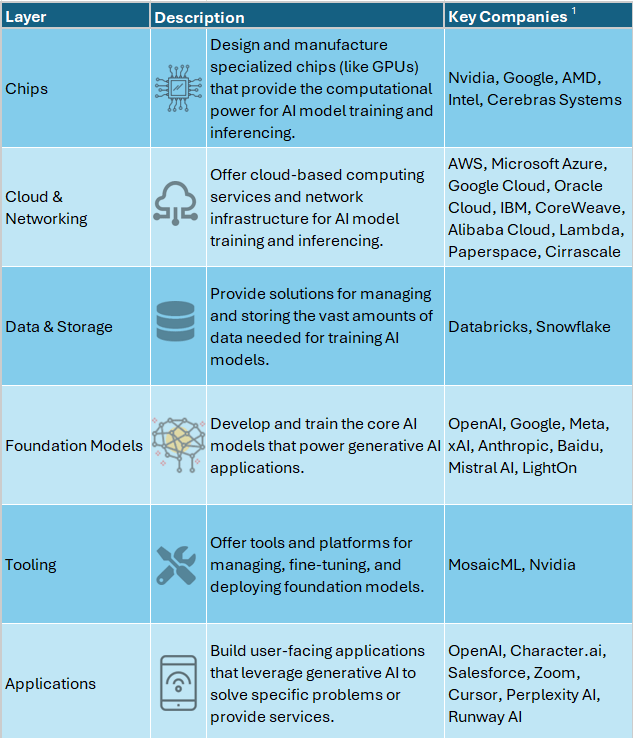
1 Based on the companies mentioned in the report operating in each layer.
This ecosystem thrives on collaboration, with partnerships playing a critical role in driving innovation and fostering the diffusion of gen AI technology. Collaborations provide participants with access to crucial resources, including funding, compute power, and specialized expertise, enabling them to innovate and scale.
Key examples of successful partnerships include:
Microsoft and OpenAI: Accelerating the development and commercialization of AI products.
Nvidia and CoreWeave: Enabling CoreWeave to scale its cloud computing services and compete with established cloud service providers.
Anthropic’s partnerships with Amazon and Google: Providing access to vast computational resources for model development and deployment.
These partnerships have resulted in tangible benefits, including improved model capabilities, decreased costs, and increased adoption of gen AI technology.
Gen AI’s Economic Potential: A Multi-Trillion Dollar Opportunity
The economic potential of gen AI is significant and far-reaching. The technology is projected to unlock value through:
Increased Labor Productivity: Automating and augmenting existing workflows, freeing up human resources for higher-value tasks.
Accelerated Innovation: Enabling the creation of new occupations, products, and services, and speeding up scientific breakthroughs.
Catalyzed Capital Investment: Driving investments in AI-specific infrastructure (e.g. power generation, chips, datacenters) and broader physical assets to support the economy’s enhanced production potential.
Focusing on labor productivity alone, gen AI could contribute $3.8 trillion annually to US GDP by 2038, driven by time savings and efficiency improvements.
Capturing the Potential : Five Key Pillars
To fully realize the economic potential of gen AI in the US, stakeholders across industry, government, and civil society must work together to foster the technology’s growth and widescale adoption. The paper proposes five key pillars to guide these efforts:
Dynamic and Innovative Ecosystem: Promoting collaboration, knowledge-sharing, and responsible risk management.
Skilled Workforces: Developing technical AI expertise, workforce digital and AI literacy, and executive understanding of gen AI.
Scalable and Accessible Infrastructure: Expanding computing resources, energy systems, and telecommunications networks.
Clear Policy Frameworks: Establishing consistent guidelines and regulatory oversight for responsible AI development and deployment.
Public Trust in Generative AI: Building trust through transparency, accountability, and equitable access to gen AI benefits.
By focusing on these pillars, the US can harness the transformative power of gen AI to drive inclusive economic growth, enhance national competitiveness, and improve the well-being of its citizens.
Conclusion
Generative AI emerges as a transformative force poised to boost the US GDP by $3.8 trillion annually by 2038, driven by unprecedented gains in labor productivity and technological innovation. This breakthrough technology positions the United States to redefine economic leadership on the global stage. By cultivating a collaborative gen AI ecosystem through strategic workforce development, critical infrastructure expansion, and comprehensive policy frameworks, the US can harness the technology’s full potential. Partnerships across industry, government, and civil society will be essential in creating an inclusive future where generative AI drives sustainable economic growth and empowers citizens.
Reference
Microsoft & Accenture. (2024, November). Unlocking the economic potential of the US generative AI ecosystem. [Report commissioned by Microsoft]. Retrieved from https://blogs.microsoft.com/on-the-issues/2024/11/21/the-3-8-trillion-opportunity-unlocking-the-economic-potential-of-the-us-generative-ai-ecosystem/
This post was researched and written with the assistance of various AI-based tools.
 AI Talks
Leave a comment