


(Images created with the assistance of AI image generation tools)
The explosive growth of artificial intelligence (AI) is the result of a confluence of factors, most notably the surge in available data and remarkable advancements in computing power. While the abundance of data has been pivotal in training sophisticated models, this post highlights the central role of microchips in the development of AI. These tiny silicon marvels are the backbone of AI development and deployment, from training complex neural networks to powering AI-driven applications across industries, transforming daily life and igniting fierce geopolitical competition for technological supremacy.
Table of Contents
- A Brief History: From Integrated Circuit to AI Accelerator
- The Intricate Process of AI Chip Manufacturing
- The Evolution of Microprocessors and the Rise of AI
- Key Roles of Microchips in the AI Ecosystem
- The Future of AI Chips: Towards Brain-Inspired and Quantum Computing
- The Chipmaking Landscape: Key Players and Industry Structure
- Geopolitical Implications: The AI Chip Arms Race
- Conclusion
- Appendix
- References
A Brief History: From Integrated Circuit to AI Accelerator
The foundation for modern AI’s computational capabilities lies in the advent of the integrated circuit. In 1958, Jack Kilby at Texas Instruments demonstrated a working integrated circuit, combining multiple electronic components on a single piece of germanium – a semiconductor material commonly used before silicon became dominant. Shortly after, Robert Noyce, then at Fairchild Semiconductor, independently developed a similar integrated circuit using silicon. These breakthroughs marked the beginning of a rapid evolution in electronics, setting the stage for what would later be formalized as Moore’s Law—the observation that the number of transistors on a chip roughly doubles every two years. This consistent advancement in computing power has been a critical catalyst for the development and advancement of artificial intelligence.
The Intricate Process of AI Chip Manufacturing
AI chip manufacturing follows the same fundamental, complex process as other advanced chips, but often requires leading-edge techniques due to their specific demands. Here is a high-level overview:
- Preparing the Base (Wafers): It starts with growing large crystals of ultra-pure silicon, which are then sliced into very thin, perfectly smooth discs called wafers. These wafers get coated with initial layers, including materials sensitive to light for the next step.
- Creating the Patterns (Patterning): In many repeating cycles, extremely detailed circuit designs are projected onto the light-sensitive wafer using special light (similar to using a stencil). Then, unwanted material is carefully removed (etched away), leaving behind the microscopic circuit shapes. The extreme precision needed for AI chips requires the most advanced versions of this patterning technique.
- Altering Properties (Doping): Also done repeatedly, specific areas of the silicon wafer are treated with tiny amounts of other elements. This changes how electricity moves through those spots, which is key to creating the chip’s working parts, like transistors.
- Adding the Wires (Wiring/Metallization): Thin layers of metal, like copper, are added and shaped across the wafer surface. This builds up a complex network of tiny wires that connect all the different components on the chip. AI chips need particularly dense and intricate wiring to handle the fast movement of large amounts of data.
- First Check (Wafer Testing): Before the wafer is separated into individual chips, each chip area is tested electrically to check if it works correctly and meets performance standards. Defective areas are marked.
- Cutting and Protecting (Packaging): The wafer is precisely cut to separate the individual chips (often called dies). Working chips are then mounted onto a base, connected with fine wires, and sealed inside a protective casing. Because AI chips use a lot of power and create significant heat, they often require special packaging methods and built-in ways to keep them cool.
- Final Check & Sorting (Final Test): After being packaged, the chips go through more thorough testing. They are often sorted (‘binned’) based on how well they perform, especially on tasks relevant to AI, before being marked with identifying information and prepared for shipping.
The Evolution of Microprocessors and the Rise of AI
The history of AI is inextricably linked to the evolution of computing hardware. Early AI research was constrained by limited computational resources and the general-purpose nature of processors at the time. However, as advancements driven by Moore’s Law delivered more raw power, innovations in chip architecture specifically suited for AI tasks progressively unlocked new possibilities:
- Early Stages (CPU-Centric): Initial AI experiments relied on general-purpose Central Processing Units (CPUs). While adequate for basic tasks, CPUs struggled with the massively parallel processing required by complex AI algorithms.
- The GPU Revolution: Graphics Processing Units (GPUs), originally designed for rendering images in video games, proved remarkably well-suited for AI workloads. Their parallel architecture allows for the simultaneous processing of vast amounts of data, dramatically accelerating the training of deep learning models. NVIDIA has become a dominant player in this space, with its GPUs widely used in data centers and research labs.
- Specialized AI Accelerators (TPUs, NPUs, FPGAs): Recognizing the unique demands of AI for both training and efficient inference, companies have developed specialized chips. These include Google’s Tensor Processing Units (TPUs), optimized for machine learning tasks, Neural Processing Units (NPUs) commonly found in edge devices, and Field-Programmable Gate Arrays (FPGAs) which can be reconfigured for specific AI workloads. These accelerators offer further gains in performance and power efficiency.
Key Roles of Microchips in the AI Ecosystem
Microchips are fundamental to virtually every aspect of AI:
- Training Deep Learning Models: Deep learning, a subfield of AI, relies on training neural networks with massive datasets. This computationally intensive process is made feasible by powerful GPUs and specialized AI chips, which significantly reduce training times and enable the development of more complex and accurate models.
- AI Inference: Once a model is trained, it’s used to make predictions or decisions – a process called inference. Microchips are crucial for efficient inference, whether in large data centers or on resource-constrained edge devices. While some chips can perform both training and inference, there’s an increasing trend towards designing specialized chips optimized for one or the other, to maximize efficiency.
- Edge Computing: AI is increasingly deployed on edge devices like smartphones, autonomous vehicles, and IoT (Internet of Things) devices. Microchips optimized for edge computing enable these devices to perform AI tasks locally, minimizing latency and enhancing responsiveness.
- Data Management and Movement: High-performance microchips, particularly those with integrated high-bandwidth memory and specialized data pathways, are essential for the efficient management and movement of the enormous datasets that AI demands. This includes memory access, data storage and retrieval, and real-time analysis, enabling applications like autonomous systems and large-scale data analytics.
The Future of AI Chips: Towards Brain-Inspired and Quantum Computing
The demand for AI chips is projected to grow exponentially as AI becomes more pervasive. While Moore’s Law has driven progress for decades, its continued pace is facing physical and economic challenges. Ongoing research and development are therefore focused on creating even more powerful and efficient chips through alternative approaches, including:
- Neuromorphic Computing: These chips mimic the structure and function of the human brain, offering the potential for significant improvements in energy efficiency and performance for certain types of AI tasks.
- Quantum Computing: While still in its early stages, quantum computing, through the development of specialized chips that harness quantum phenomena, holds the promise of solving complex AI problems that are currently intractable for classical computers.
The Chipmaking Landscape: Key Players and Industry Structure
The semiconductor industry is characterized by a diverse ecosystem of companies, each playing a vital role:
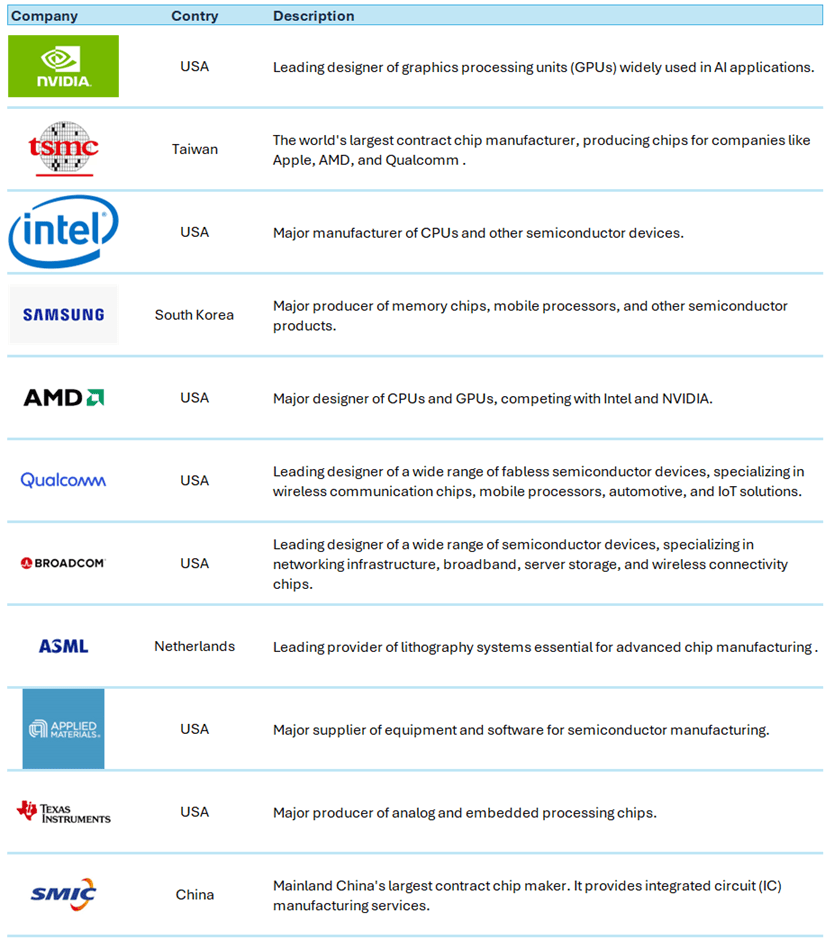
- Integrated Device Manufacturers (IDMs): Companies like Intel (USA) and Samsung (South Korea) both design and manufacture chips. Intel is a major producer of CPUs, while Samsung is a leading manufacturer of memory chips and mobile processors.
- Foundries: Companies like TSMC (Taiwan) specialize in manufacturing chips on a contract basis for other companies (“fabless” companies) that lack their own fabrication facilities. TSMC is the world’s largest contract chip manufacturer.
- Fabless Semiconductor Companies: Companies like NVIDIA (USA) and Qualcomm (USA) focus exclusively on chip design and outsource manufacturing to foundries. NVIDIA is a leader in GPU design, while Qualcomm is a major player in mobile processors.
- Equipment Providers: Companies such as ASML (Netherlands) supply the essential lithography systems and other specialized machinery crucial for the chip manufacturing process.
- Other Essential Suppliers: The industry also includes companies that provide materials, packaging, and testing services (e.g., ASE Technology Holding, Teradyne). These companies are critical for various stages of chip production.
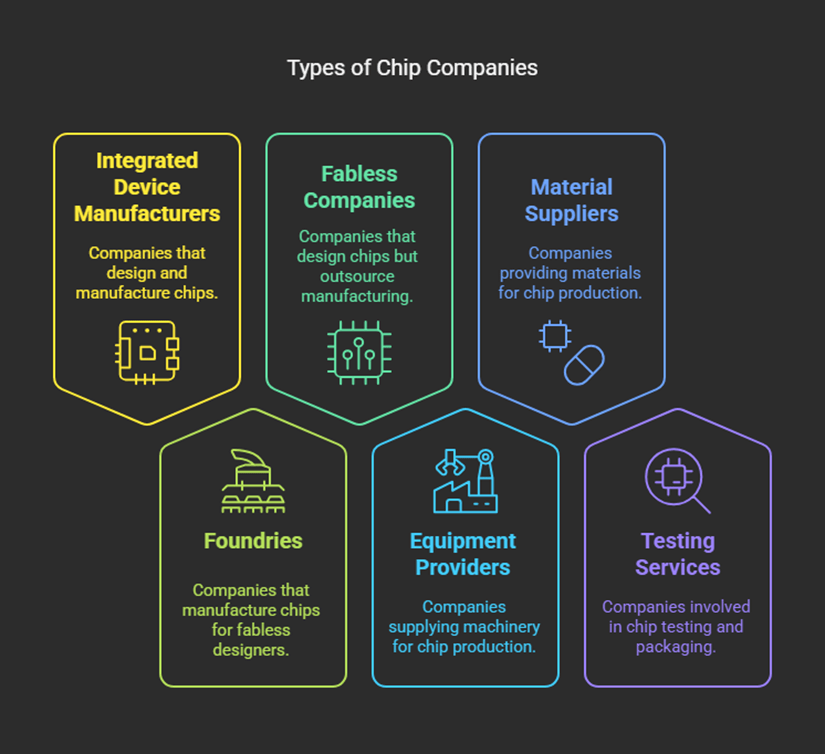
AI Talks Blog. Diagram generated using Napkin AI (napkin.ai)
Geopolitical Implications: The AI Chip Arms Race
The critical role of microchips in AI has transformed them into a focal point of geopolitical competition, particularly between the United States and China. Both nations recognize AI’s strategic importance for economic and military dominance, leading to a race to control the design and manufacture of advanced AI chips.
- US Export Controls: The United States has imposed export controls on advanced AI chips and chipmaking equipment to China, aiming to limit China’s access to the technology needed to develop cutting-edge AI systems.
- China’s Drive for Self-Sufficiency: China is investing heavily in its domestic semiconductor industry to reduce its reliance on foreign technology. The Chinese government views the US restrictions as an attempt to hinder its technological progress.
- Strategic Significance: The ability to design and manufacture advanced AI chips is vital for developing AI-powered military systems, surveillance technologies, advanced space exploration capabilities, and other applications with significant strategic implications. This has fueled concerns about a potential technological arms race.
- Global Supply Chain Vulnerabilities: The concentration of chip manufacturing in a few regions, especially Taiwan, raises concerns about supply chain disruptions. Geopolitical tensions, such as trade restrictions, conflicts, or natural disasters impacting manufacturing hubs, could disrupt the flow of chips, impacting industries globally.
Conclusion
Microchips are the basic building blocks of AI, powering everything from huge data centers to tiny devices on the edge of the network. But because they’re so important, they’ve become a key part of the competition between countries, especially between the US and China. The country that controls the best AI chips will have a big advantage. This race to make the best chips is changing AI and how countries relate to each other. As AI gets better and better, the connection between new technology and world politics will become even more important. We’ll need to be very careful to make sure that AI keeps improving while also keeping the world stable.
Appendix
References
Bureau of Industry and Security. “Commerce Strengthens Restrictions on Advanced Computing Semiconductors, Semiconductor Manufacturing Equipment, and Supercomputing Items to Countries of Concern.” U.S. Department of Commerce, 17 Oct. 2023, https://www.bis.gov/press-release/commerce-strengthens-restrictions-advanced-computing-semiconductors-semiconductor-manufacturing-equipment. Accessed 26 Mar. 2025.
“Global Artificial Intelligence (AI) Chip Market to Worth Over US$ 501.97 Billion by 2033.” GlobeNewswire, 19 Feb. 2025, https://www.globenewswire.com/news-release/2025/02/19/3028772/0/en/Global-Artificial-Intelligence-AI-Chip-Market-to-Worth-Over-US-501-97-Billion-By-2033-Astute-Analytica.html. Accessed 26 Mar. 2025.
KLA. “Semiconductor Manufacturing 101.” KLA, 30 Sep. 2021, https://www.kla.com/advance/education/chip-manufacturing-101. Accessed 26 Mar. 2025.
Miller, Chris. Chip War: The Fight for the World’s Most Critical Technology. Scribner, 2022.
NobelPrize.org. “Jack Kilby Facts.” The Nobel Prize, The Nobel Foundation, 2000, www.nobelprize.org/prizes/physics/2000/kilby/facts/. Accessed 26 Mar. 2025.
This post was researched and written with the assistance of various AI-based tools.
 AI Talks
Leave a comment