

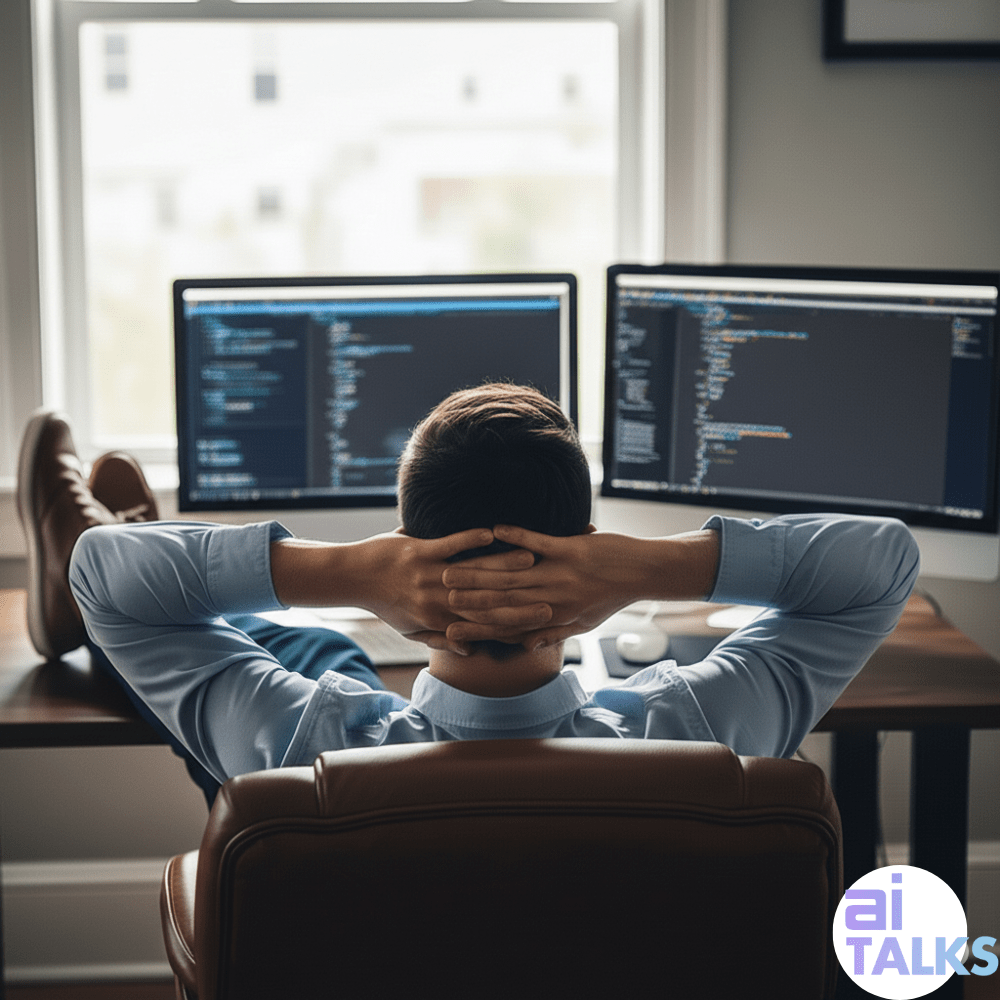
(Images created with the assistance of AI image generation tools)
Technology now touches nearly every part of our lives. The way we create it keeps changing. Most people know software developers write complex code. But what if making software meant simply expressing an idea or “vibe”? This post explores “vibe coding” – a new approach that democratizes and reshapes software creation.
Table of Contents
What Exactly is “Vibe Coding”?
Coined by Andrej Karpathy of OpenAI in early 2025, ‘vibe coding’ leverages AI and Large Language Models for software development. Developers describe desired outcomes in natural language instead of writing code in Python, Java, or C++. The AI converts these descriptions into actual code.
For example, to create an app to manage work and break schedules, you’d explain the key functions to an AI. You’d describe features like custom work and break durations, transition alerts, and cycle tracking. The AI would generate the functional application from your description.
This shifts humans from writing code to supervising AI. People define the ‘what’ and ‘why’ while AI builds the ‘how.’
The Appeal of Vibe Coding
Vibe coding offers several key benefits:
Increased Accessibility and Speed: The barrier to entry drops significantly. Non-programmers can bring ideas to life. Experienced developers save time on initial development phases. Rapid prototyping replaces hours spent on boilerplate code.
Enhanced Creativity: Technical complexities fade into the background. Creators, entrepreneurs, and experts can build custom tools for specific needs. This enables niche applications that weren’t previously viable.
Focus on the “Big Picture:” Developers spend less time on syntax details. They concentrate more on user experience and core logic. This results in more thoughtful, user-centered applications.
Process Automation: Many sectors can automate routine tasks like data entry and document processing. This frees human resources for more complex work and improves service delivery.
The Downsides of Vibe Coding
Despite its potential, vibe coding presents several challenges:
Code Quality Issues: AI generates code quickly but not always efficiently. “Messy” code creates technical debt. Maintaining unfamiliar AI-generated code can prove difficult.
Security Vulnerabilities: AI might introduce security flaws. Rigorous testing by experienced developers remains essential.
Skill Degradation Risk: Over-reliance on AI might hinder development of core programming skills. Understanding software engineering principles remains crucial for solving complex problems.
Complexity Limitations: Simple applications benefit most from vibe coding. Large, complex systems still require traditional coding approaches. AI struggles with intricate architectural decisions.
Interpretation Challenges: Success depends on clear natural language prompts. Ambiguous descriptions lead to incorrect code, requiring multiple refinements.
Vibe Coding and the Future of Programming
Vibe coding won’t replace traditional programming. It’s a powerful addition to developers’ toolkits that makes software development more intuitive and accessible.
The future likely involves collaboration between human creativity and AI. Developers will use AI for repetitive tasks and initial frameworks. They’ll apply their critical thinking, expertise, and ethical judgment to guide and validate AI output.
As AI advances, natural language instructions will become more nuanced. Generated code will grow more sophisticated and reliable. For users, this means technology that better adapts to individual needs.
Conclusion
‘Vibe coding’ marks a turning point in human-technology interaction. It democratizes creation by reducing syntax barriers. Despite challenges in code quality and security, the future looks promising. Human creativity, enhanced by AI, will bring more ideas to life. Technology will better reflect our collective vision, letting more people “speak” code.
Learn More
Berman, Matthew. “What is Vibe Coding? ” YouTube, 13 Feb. 2025, https://www.youtube.com/watch?v=8TQaJDCw-dE. Accessed 19 May 2025.
filipecalegario. “awesome-vibe-coding.” GitHub, https://github.com/filipecalegario/awesome-vibe-coding. Accessed 19 May 2025.
Hodgkiss, Steve. “The Rise Of Vibe Coding Innovation Or Illusion.” stevehodgkiss.net, 24 Mar. 2025, https://stevehodgkiss.net/post/the-rise-of-vibe-coding-innovation-or-illusion. Accessed 19 May 2025.
quin creativ. “The Art of Vibe Programming, Coding + Building (for creators).” quin creativ, 5 Apr. 2025, https://www.quincreativ.com/blog/vibe-coding. Accessed 19 May 2025.
This post was researched and written with the assistance of various AI-based tools.
 AI Talks
Leave a comment