

(Images created with the assistance of AI image generation tools)
Financial markets move fast—and so should your analysis tools. Traditional Python scripts often lock analysts into rigid workflows, where each new question requires time-consuming code changes. This process is slow, inefficient, and keeps analysts focused on programming mechanics instead of market insights.
In this post, we will cover how to build an AI agent that moves beyond these static scripts. We will walk through how to transform a standard Python function into a flexible capability and pair it with a large language model (LLM) to create an intelligent assistant that understands natural language and generates comparative financial analysis instantly.
Table of Contents
What Are AI Agents and Why Are They a Game-Changer?
At its core, an AI agent is a system that perceives its environment and takes actions to achieve a specific goal. Think of it as a smart assistant you can give a high-level task to. Instead of telling it how to do something step-by-step, you just tell it what you want to achieve.
The agent’s magic lies in its ability to:
- Reason: Understand your request.
- Plan: Break down the request into a series of logical steps.
- Use Tools: Execute actions like running code or fetching data from the web.
- Observe: Analyze the results of its actions and adjust its plan accordingly.
This is a massive leap in efficiency. For stock analysis, it means moving from being a data-gatherer to a decision-maker and letting the agent handle the grunt work.
Building The Stock Analysis Agent
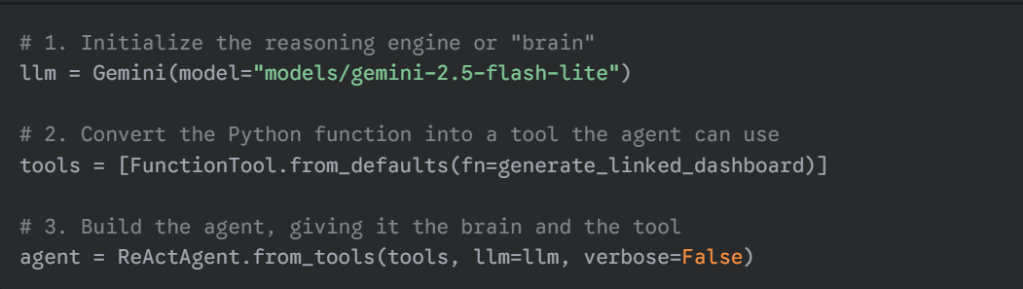
Let’s dive into the Python script that makes this possible. We’ll use the popular llama-index library to assemble our agent from three core components.
1. The “Brain”: The Language Model (Google’s Gemini)
The brain of our operation is the Large Language Model (LLM). It’s the core reasoning engine that understands our commands and formulates the plan. A high-quality LLM is crucial because it ensures the agent can reliably interpret our goals and the information it gathers.
2. The “Capability”: The Tool (generate_linked_dashboard)
An agent’s brain is powerful, but it needs tools to interact with the world. Instead of a single-use script, we build a versatile function designed to handle variation. This function enables our agent to fetch historical stock price data, calculate returns, and build an interactive HTML dashboard.

3. The “Orchestrator”: The ReActAgent
This is where everything comes together. The ReActAgent framework manages the entire process (ReAct stands for Reason and Act). It works in a loop: It reasons about the goal, decides which tool to act with, and then observes the result to inform its next step. When verbose=True, the agent’s entire thought process is printed to the terminal—a fascinating output that feels like observing a brilliant assistant at work.
In summary, this is how the agent’s ‘brain,’ ‘tool,’ and ‘orchestrator’ work together. The LLM acts as the brain to understand user intent, the FunctionTool prepares our Python function as a usable tool, and the ReActAgent serves as the orchestrator, translating requests into actions. The image below shows this entire structure implemented in just a few lines of code.
How It Works in Practice
Once built, the agent transforms financial analysis into simple conversation. Bounded by its tools yet flexible within that scope, it handles any relevant request without code modifications.
Consider how this unfolds in practice. When a user makes a request like:
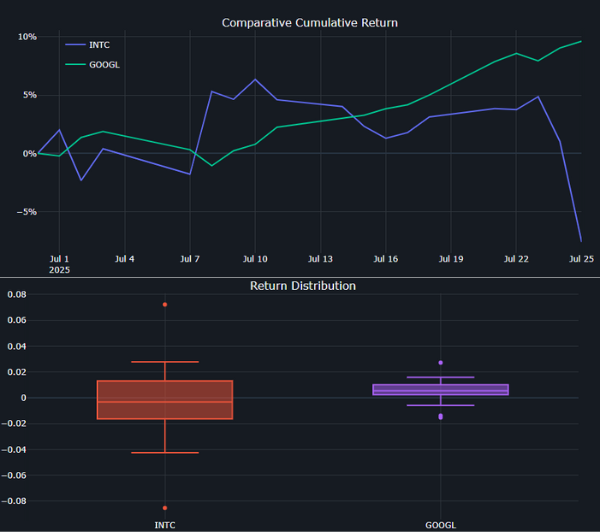
“Provide a comparative dashboard for INTC and GOOGL over the last 30 days”
the agent immediately parses the intent and executes generate_linked_dashboard(tickers=[‘INTC’, ‘GOOGL’], days=30) behind the scenes. The interaction feels effortless—natural language seamlessly converts to practical analysis.
The agent’s adaptability becomes clear when handling variations. Take a follow-up request such as:
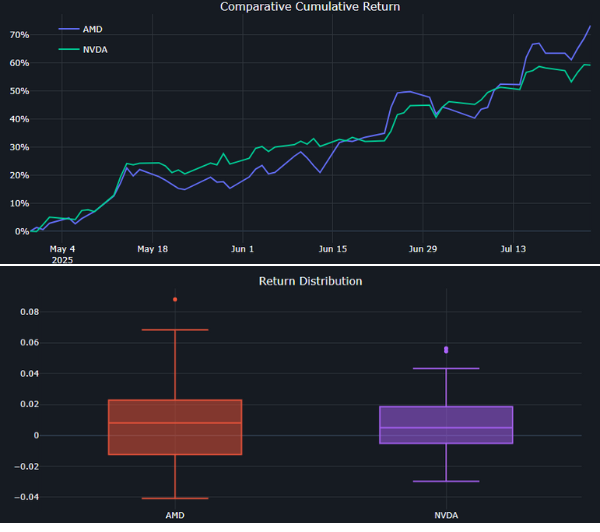
“Show me a 3-month comparison of AMD and NVDA.”
Here, the agent encounters new tickers and a different timeframe yet handles both seamlessly. It interprets “3-month” as a 90-day period and calls generate_linked_dashboard(tickers=[‘AMD’, ‘NVDA’], days=90) without hesitation.
For each request, the agent generates a functional HTML dashboard within seconds. It features two linked, side-by-side charts—the Comparative Cumulative Return and the Return Distribution—that deliver useful insights typically requiring manual coding.
The two charts that comprise the generated dashboard are displayed below, for both the initial and the follow-up requests.
The Future of Finance is Agent-Driven
By transforming static code into analytical power, AI agents unlock vast new capabilities. This dashboard is merely a glimpse of the potential. Imagine an ecosystem of agents equipped with tools for real-time sentiment analysis, portfolio optimization, and complex market shock simulations.
This evolution fundamentally changes how analysts work. The focus shifts from coding mechanics to analytical strategy, creating a fusion of human strategic thinking and AI’s rapid insight generation that scales seamlessly with market complexity.
Ressources
- Try the Code: The complete Python script for this project is available on GitHub: aitalksblog/AI_StockAnalysis.
- Building an Agent: This official guide explains the core concepts behind building and using agents with LlamaIndex. Learn more at Building an Agent.
- About Gemini: Gemini is a family of powerful, multimodal large language models developed by Google. You can find a list of available Gemini models and their capabilities at Google AI for Developers.
This post was researched and written with the assistance of various AI-based tools.
 AI Talks
Leave a comment