

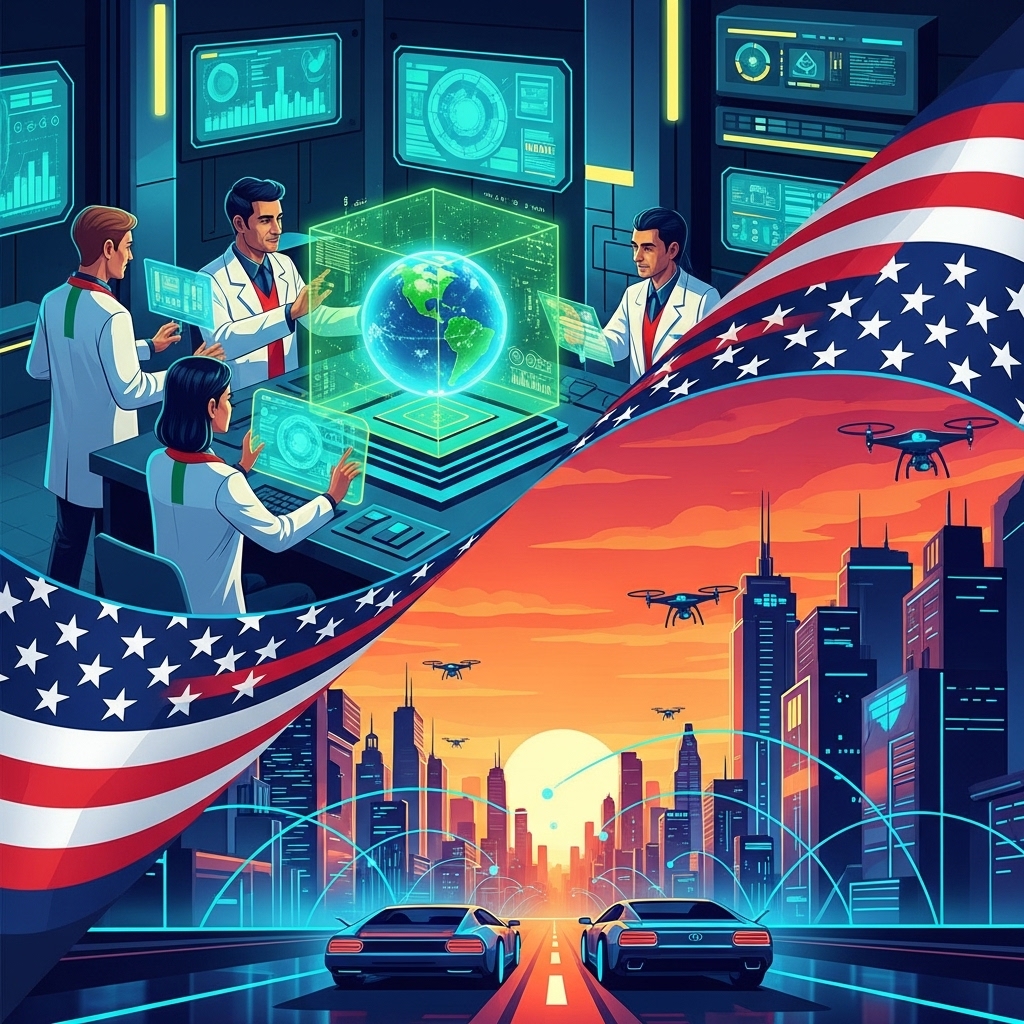
(Images created with the assistance of AI image generation tools)
The United States stands at a crossroads, facing a choice between two profoundly different futures for artificial intelligence. This isn’t just a technical debate; it’s a fundamental disagreement over how to balance immense promise with potential peril.
The established policies of the Biden administration, which prioritized building trust through careful stewardship, now stand in stark contrast to the prospective framework of a second Trump administration, which seeks to win a global race through aggressive acceleration and a mandate for ‘woke-free’ technology. These competing visions will shape US economy, national security, and society for decades to come.
Understanding this divergence is critical for anyone invested in the future of technology.
Table of Contents
- The Biden Blueprint: Building Trust Through Safety
- The Trump Playbook: Winning the Race at All Costs
- The Ideological Fault Line: “Equitable AI” vs. “Woke-Free AI”
- Common Ground: The China Imperative
- What’s at Stake?
- Further Reading
The Biden Blueprint: Building Trust Through Safety
The Biden administration’s approach to AI was built on a philosophy of precautionary governance. Its landmark Executive Order 14110, “Safe, Secure, and Trustworthy Development and Use of Artificial Intelligence,” established a comprehensive, coordinated federal framework to manage AI’s risks proactively. President Biden argued that to “realize the promise of AI and avoid the risk, we need to govern this technology”.
This philosophy holds that for the U.S. to lead, AI must first earn public trust. The policy focused on mitigating a wide range of societal harms, including algorithmic bias, discrimination, and privacy violations. Key actions included requiring developers of the most powerful AI models to report their safety testing results to the government and directing agencies to protect civil rights from AI-driven harms in areas like housing and employment. This strategy was also inherently multilateral, seeking to build a global consensus with allies on a common set of rules for responsible AI.
The Trump Playbook: Winning the Race at All Costs
A second Trump administration’s AI policy is framed as a zero-sum geopolitical competition, centered on national security, economic prosperity, and technological leadership. Its foundational actions—the immediate revocation of Executive Order 14110 and the rollout of “Winning the Race: America’s AI Action Plan“—signal a dramatic shift. This approach champions rapid, private-sector-led innovation, aggressive deregulation, and massive infrastructure investment as the primary tools for achieving American technological supremacy.
The Trump plan redefines risk, shifting the focus from societal harms to the dangers of regulatory burdens that could hinder the pace of innovation. It aims to remove “red tape” and even proposes using federal funding as leverage to discourage states from enacting their own “burdensome” AI laws. This “growth-first” philosophy posits that the government’s role is not to regulate but to clear the path for industry to win the AI race.
The Ideological Fault Line: “Equitable AI” vs. “Woke-Free AI”
Nowhere is the divide between the two administrations clearer than on the issue of “bias.” The Biden administration treated discrimination and abuse as a key technical and societal risk to be engineered out of AI systems. Its policies directed agencies to actively prevent AI from deepening discrimination in critical areas like criminal justice and public benefits.
The Trump administration’s “Preventing Woke AI in the Federal Government” executive order rejects the idea that bias is a systemic problem. Instead, it redefines the issue as the deliberate insertion of “ideological dogmas” like diversity, equity, and inclusion (DEI). The order directs federal agencies to buy only AI models that are certified as “ideologically neutral” and free from such “dogmas.
The “anti-woke” mandate, despite being presented as deregulation, creates a new and unclear set of compliance rules for companies that want to work with the government. Critics say this forces developers into “coerced ideological compliance,” because they have to guess what unwritten standards the administration will enforce. This new system may be harder for the industry to navigate than the previous administration’s more extensive but clearer safety rules.
Common Ground: The China Imperative
Despite these profound differences, a crucial area of strategic continuity exists: both administrations identify the AI competition with China as a paramount national security imperative. This shared threat perception has led to rare bipartisan agreement on certain issues, such as continued support for the CHIPS and Science Act to onshore advanced semiconductor manufacturing.
However, the strategies for victory diverge. The Biden administration pursued a coalition-based approach of “allied guardrails” to contain autocratic AI. The Trump administration favors a strategy of “dominance through diffusion,” aiming to out-produce competitors and create global dependence on an “American AI Stack” by aggressively promoting its export.
What’s at Stake?
The choice between these two futures—one defined by responsible stewardship, the other by assertive dominance—will have lasting consequences. The Biden path risks a slower pace of innovation, while the Trump path risks eroding public trust and alienating allies. For the AI industry, this policy whiplash creates significant uncertainty, forcing companies to prepare for a volatile regulatory environment where the definition of “compliance” can shift overnight.
Ultimately, the central challenge for the United States is to forge a sustainable strategy that fosters both the rapid innovation needed to compete globally and the enduring public trust required for lasting leadership. The path chosen will determine not only the future of the technology but also the structure of the American economy and the global balance of power.
Further Reading
The President. (2023, November 1). Safe, secure, and trustworthy development and use of artificial intelligence, Executive Order 14110. Federal Register, 88(210), 75191–75226. https://www.federalregister.gov/documents/2023/11/01/2023-24283/safe-secure-and-trustworthy-development-and-use-of-artificial-intelligence
Boak, J., & O’Brien, M. (2023, October 30). Biden wants to move fast on AI safeguards and signs an executive order to address his concerns. AP News. https://apnews.com/article/biden-ai-artificial-intelligence-executive-order-cb86162000d894f238f28ac029005059
Ebbink, B. M., & Walton, D. J. (2025, January 23). Trump rolls back Biden’s AI executive order and makes AI infrastructure push: Key takeaways for employers. Fisher Phillips. https://www.fisherphillips.com/en/news-insights/trump-rolls-back-bidens-ai-executive-order.html
The White House. (2025, July 23). White House unveils America’s AI action plan. https://www.whitehouse.gov/articles/2025/07/white-house-unveils-americas-ai-action-plan/
Abrams, E. T., & Fleming, B. J. (2025, February 25). The Trump administration’s AI agenda: What it means for national security. Steptoe. https://www.steptoe.com/en/news-publications/steptechtoe-blog/the-trump-administrations-ai-agenda-what-it-means-for-national-security.html
This post was researched and written with the assistance of various AI-based tools.
 AI Talks
Leave a comment