
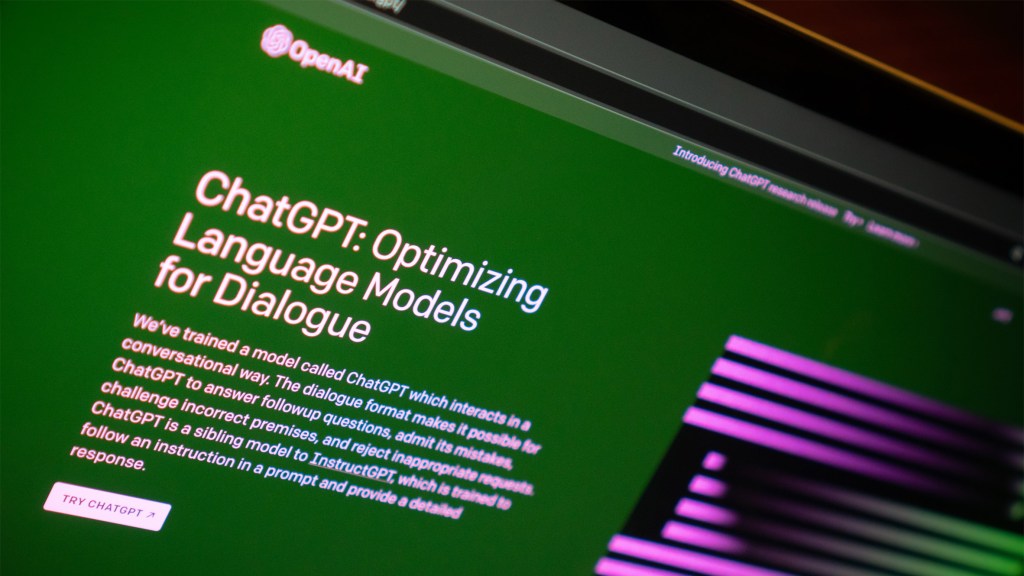

Just under a year ago, except within a small circle in Silicon Valley and among tech enthusiasts, ChatGPT was relatively unknown. Today, it is ubiquitous, and numerous media platforms discuss or reference it.
Since its launch in November 2022 by OpenAI, ChatGPT has gained significant attention for its impressive capabilities, leading to a rapid growth in its user base. It’s highly probable that you have already encountered this tool, experimented with it, or even incorporated it into your daily workflow to boost productivity. However, if you are new to ChatGPT, this post aims to provide you with an overview of this popular chatbot, discuss its limitations, and offer practical tips to make the most of it while considering its limitations.
What’s in the name ?
Chat (for chatbot) : a machine (computer program) that can simulate human conversation
G (Generative) : ability to generate creative content (text in this case)
P (Pre-trained) : ChatGPT is powered by a language model which was trained on a large set of text data to learn the structure and patterns of language
T (Transformer) : the type of neural network architecture that enables ChatGPT to process natural language effectively and to generate responses that are contextually coherent and relevant.
Putting it all together
ChatGPT is a conversational tool or chatbot that interacts with users by generating human-like text based on its model’s training data and the Transformer architecture.
It is important to note that ChatGPT lacks a genuine understanding of natural language. When generating a response, it relies on statistical patterns and associations its model learned during training to make an educated guess based on the context given.
Features and capabilities
ChatGPT is running on GPT 3.5, a modified version of the GPT3 model that was introduced in 2020 by OpenAI. GPT-3 is an advanced language model that utilizes transformer neural networks. It is trained on a massive amount of text data (web pages, internet posts, books, articles, etc.) and contains 175 billion parameters[1] that encapsulate the “learning” gained during the training process.
Another factor that enhances ChatGPT’s capabilities is its ability to continually refine its performance through reinforcement learning (RL). This mechanism allows ChatGPT to gather user feedback on its generated content in order to improve its responses over time.
With its foundation on the GPT-3 architecture, vast training text data, and continuous improvement through RL, ChatGPT demonstrates an array of capabilities and can assist with a wide range of language tasks, including:
- programming
- summarizing text
- answering questions
- translating languages
- generating content
- learning support
Limitations and mitigation approaches
While ChatGPT has remarkable capabilities, it is essential to acknowledge its shortcomings. Some of the limitations associated with its usage are :
- Hallucination: ChatGPT can generate responses that seem accurate but are factually incorrect or fictional.
- Disinformation and Misinformation: ChatGPT has the potential to generate false information, which can then be intentionally spread (disinformation), or produce incorrect facts that reflect inaccuracies present in its training dataset (misinformation).
- Copyright Infringement: Since GPT-3 is trained on a vast corpus of text data that include copyrighted materials, ChatGPT may produce information that violates intellectual property rights.
- Bias : ChatGPT’s responses may echo existing biases present in its training data, further perpetuating those biases.
- Lack of access to up-to-date data : ChatGPT’s knowledge is derived from its training data, which is limited to information collected up until September 2021.
Due to the potential weaknesses outlined, it is important to exercise caution when relying on responses generated by ChatGPT, especially when there is a potential for adverse impact or legal liability resulting from the use of inaccurate, biased, or unauthorized information.
To make the most of ChatGPT while mitigating its shortcomings, these principles should serve as a helpful guide :
- Verify Information (cross-check information generated to ensure accuracy)
- Exercise Critical Thinking (be aware of the tool’s potential biases when interpreting responses)
- Make Ethical Use (respect intellectual property rights; do not use to spread inaccurate information)
- Know its limitations (in order to use it responsibly)
Tips For Effective Interactions with ChatGPT
When it comes to interacting with ChatGPT, crafting well-designed prompts can enhance the overall conversation and help you receive more accurate and relevant output. Here are some tips for writing effective prompts that make interacting with ChatGPT more fun and valuable.
- Be clear and specific: provide clear instructions to get relevant responses.
- Contextualize: share relevant background information to assist ChatGPT in better understanding the request
- Experiment with different wording: try rephrasing the prompt or question to see if it ChatGPT produces a better result.
- Use examples: provide specific examples or scenarios to guide ChatGPT’s understanding.
- Specify the desired format: mention in the prompt the preferred format or structure for the response.
- Iterative refinement: ask ChatGPT to try again with more specific instructions if the initial response is not satisfactory.
Additional information:
- To gain access to ChatGPT :
- Visit the OpenAI website[2] and sign up (free)
- Download the official OpenAI ChatGPT app from the Apple store.
- OpenAI offers ChatGPT Plus as a subscription service priced at USD $20 per month at the time of writing. This premium version runs on GPT-4, which is the latest iteration of OpenAI’s language model system and was launched in March 2023.

 AI Talks
Leave a reply to Transforming Noisy Investor Reactions into Actionable Financial Insights with ChatGPT – AI Talks Cancel reply