
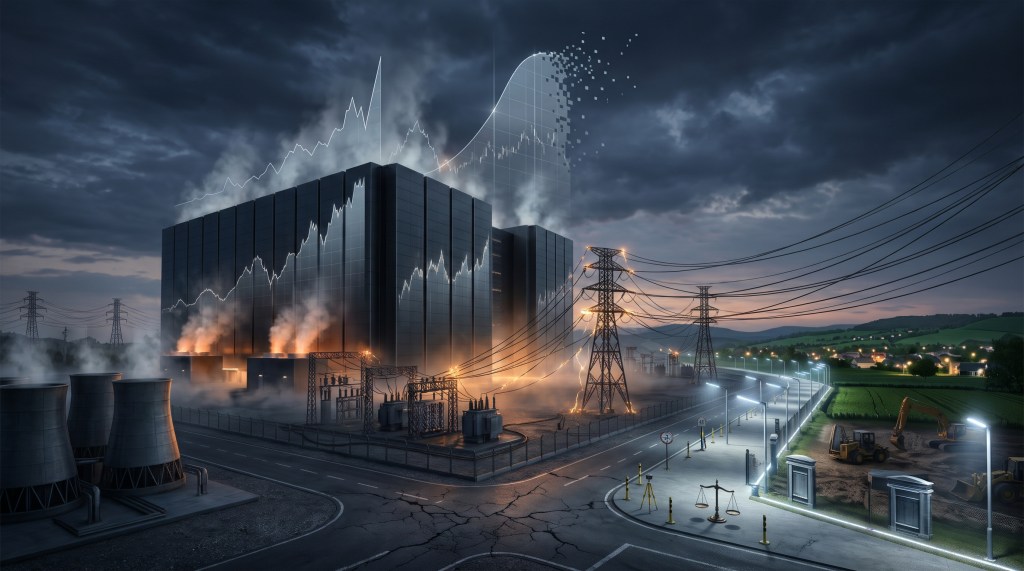
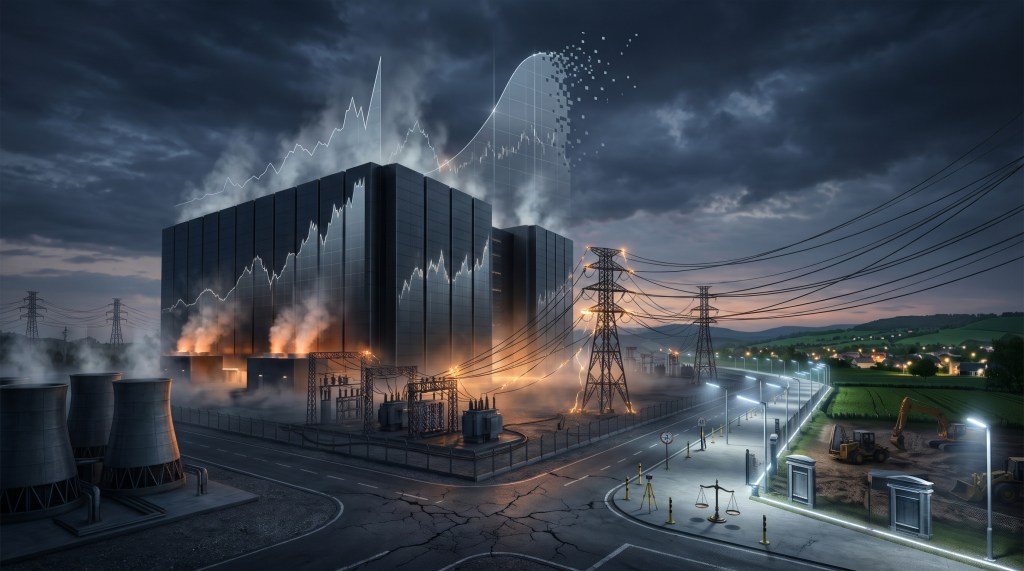
(Images created with the assistance of AI image generation tools)
The artificial intelligence investment thesis has moved past the initial phase of broad, indiscriminate capital allocation. As articulated in Aswath Damodaran’s institutional analysis, The AI Trade Deconstructed: AI Builders, AI Suppliers And AI Product Firms, the market can no longer be evaluated as a monolithic thematic trade. Instead, the ecosystem divides into four distinct structural tiers, each characterized by fundamentally divergent cash flow profiles, capital expenditure obligations, and margin trajectories.
Table of Contents
Structural Breakdown of the Artificial Intelligence Ecosystem
The divergence between these operational groups establishes why market participants cannot apply uniform valuation multiples across the AI value chain:
- Upstream AI Suppliers: Comprising semiconductor designers such as Nvidia, electrical equipment manufacturers, utility-scale power generation providers, and specialized data center real estate operators. This tier captured the earliest and most concentrated financial windfall of the cycle. Because building AI infrastructure required immediate physical hardware and physical facilities, capital flowed upstream instantly, converting directly into recognized revenues, peak initial margins, and immediate profits.
- Hyperscale AI Builders: Encompassing major cloud platform providers, including Alphabet, Amazon, Meta, Microsoft and Oracle. These entities bear the structural burden of financing the physical foundation of AI. Committing hundreds of billions of dollars in capital expenditures toward data center infrastructure, these builders face sustained downward pressure on free cash flows. Their return on investment remains contingent upon deferred, long-term monetization schedules rather than immediate operational liquidity, although their massive balance sheets grant them relative operational resilience.
- Frontline AI Product Creators: Representing application developers and software platforms (such as public market leader Palantir) alongside frontier model labs (such as OpenAI and Anthropic) that are private companies currently in the process of transitioning toward public listings (following the trajectory of early listings like SpaceX). These high-growth, research-intensive enterprises confront a classic duration problem: they must enter into long-term, capital-intensive compute agreements with builders and suppliers, while their incoming revenues rely on volatile, short-cycle, usage-based fees and early-stage subscription models.
- Downstream AI Customers: Representing enterprise clients and retail market participants whose technology adoption dictates systemic viability. The collective economic capitalization of the entire AI ecosystem rests upon whether commercial adoption can scale quickly enough to rationalize the trillions of dollars committed upstream.
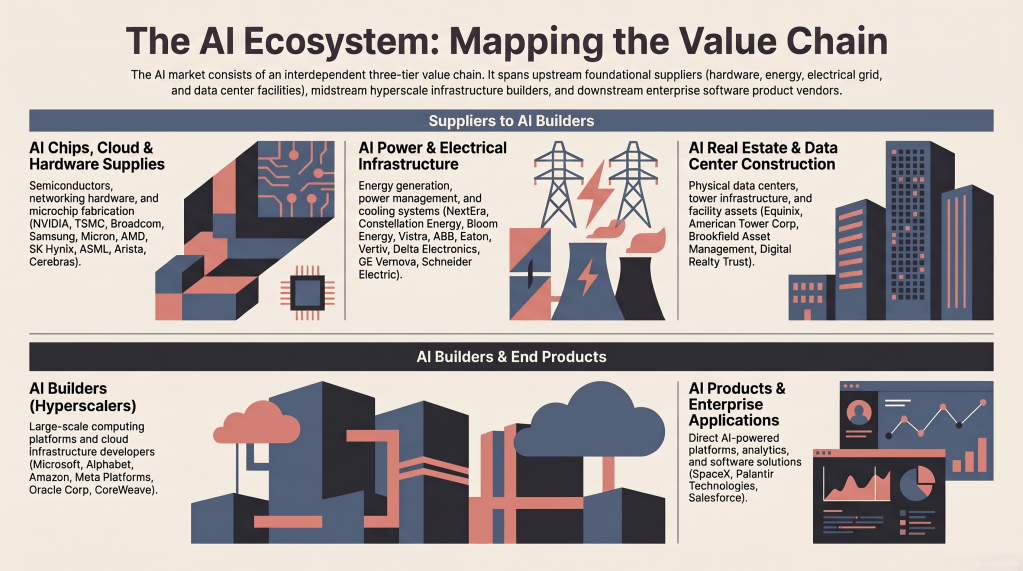
The structural relationship among these tiers reveals an asymmetric distribution of financial risk. While upstream suppliers converted early liquidity into recognized profits, hyperscalers and product firms have accumulated heavy capital commitments, creating structural vulnerability if downstream enterprise adoption fails to accelerate at projected speeds.
| Ecosystem Tier | Core Economic Role | Cash Flow & Margin Profile | Primary Structural Risk |
|---|---|---|---|
| AI Suppliers | Upstream hardware, physical infrastructure, energy delivery, and real estate | Immediate revenue conversion, peak initial margins, rapid liquidity extraction | Cyclical deceleration in CapEx spending and physical capacity constraints |
| AI Builders (Hyperscalers) | Cloud computing backbone, massive cluster deployment, facility construction | Depressed free cash flow due to multi-hundred-billion CapEx outlays; strong balance-sheet resilience | Capital misallocation and extended time horizons for monetization |
| AI Products | Frontier foundation models, applied software, enterprise workflow tools | High R&D intensity, volatile subscription and consumption revenue | Severe duration mismatch between fixed compute leases and recurring revenue |
| AI Customers | Ultimate demand drivers, technology absorption, operational integration | Operating expense outlays for software licenses and computing access | Insufficient return on invested capital to justify ongoing commercial adoption |

Market Dynamics, Divergence, and the “Big Market Delusion”
Between 2023 and 2025, market pricing reflected synchronized momentum, lifting equity valuations across virtually every corporate entity associated with artificial intelligence. Entering 2026, this generalized momentum has fractured into sharp divergence. The broad trade—defined by passive, unselective buying of AI-adjacent equities—has officially ended under the weight of operational realities and localized economic bottlenecks.
This transition reflects the classic framework of the Big Market Delusion. In this dynamic, the undisputed promise of a massive future addressable market merges with executive overconfidence. Corporate leadership teams across multiple sectors simultaneously deploy massive capital budgets under the assumption that each individual firm will capture a dominant market share. The mathematical consequence of this collective overreach is systemic overinvestment, margin compression, and inevitable market corrections.
Compounding this valuation risk are intensifying macro and regulatory headwinds targeting the physical footprint of artificial intelligence:
- Physical and Density Constraints: Data center clusters place severe strains on regional electrical grids, utility capacities, and local land availability.
- Voter and Regulatory Pushback: Local communities and political bodies have mounted resistance against data center density. This friction threatens to introduce permitting bottlenecks, higher utility tariffs, and tighter operational oversight.
- Divergent Sector Impacts: While hyperscale cloud builders possess the diversified balance sheets and capital buffers needed to remain relatively resilient, upstream hardware, electrical, and power suppliers face compressed operating margins and delayed project timelines as capacity expansion schedules slow down.
Tactical Portfolio Implication
Given this reality, tactical portfolio management requires a differentiated sector reassessment. As infrastructure spending slows down, hardware and power suppliers will experience tighter profit margins and slower revenue growth. Meanwhile, AI software and application companies will face heavy pressure to prove their core business model is actually profitable on a per-customer basis.
Rather than timing macro tops or bottoms, long-term investors should use volatility-driven pulldowns as systematic opportunities to trim concentrated legacy winners and scale into mispriced assets using strict intrinsic valuation limits.
Reference
Damodaran, Aswath. “The AI Trade Deconstructed: AI Builders, AI Suppliers And AI Product Firms.” Seeking Alpha, 11 Nov. 2026.
This post was researched and written with the assistance of various AI-based tools.


Leave a Reply